ঢাকা, বৃহস্পতিবার, ১৬ জুলাই, ২০২৬, ১ শ্রাবণ ১৪৩৩
লাইভ
Sri Lanka U19২৫৭/০
India U19
Day 3: Rain stops play - India U19 ১৬৭ রানে পিছিয়ে
West Indies১৩৮/১০
New Zealand১৪১/৫
New Zealand ৫ উইকেটে জয়ী
Ireland Women২৪১/৭
West Indies Women২৪২/৪
West Indies Women ৬ উইকেটে জয়ী
সব ম্যাচ →
ফুটবল
এই মুহূর্তে কোনো ম্যাচের তথ্য নেই
সব ম্যাচ →
← সব টুর্নামেন্ট
Cricket World Cup 2011

Cricket World Cup 2011

India Sri Lanka Bangladesh
তথ্যাদি
Dates19 February – 2 April 2011
AdministratorInternational Cricket Council
Cricket formatOne Day International
Tournament format(s)Round-robin and Knockout
HostsIndia, Sri Lanka, Bangladesh
ChampionsIndia (2nd title)
Runners-upSri Lanka
Participants14 (from 104 entrants)
Matches49
Attendance1,229,826 (25,098 per match)
Player of the seriesYuvraj Singh
Most runsTillakaratne Dilshan (500)
Most wicketsShahid Afridi (21) , Zaheer Khan (21)
The 2011 ICC Cricket World Cup was the tenth Cricket World Cup. It was played in India, Sri Lanka and Bangladesh, the latter hosting World Cup matches for the first time. India defeated Sri Lanka by six wickets in the final at Wankhede Stadium in Mumbai, thus becoming the first country to win the Cricket World Cup final on home soil. India's Yuvraj Singh was declared the player of the tournament. This was the first time in World Cup history that two Asian teams had contested the final. It was also the first time since the 1992 World Cup that the final did not feature Australia.

Host selection

The International Cricket Council (ICC) announced on 30 April 2006 which countries would host the 2011 World Cup. Australia and New Zealand had also bid for the tournament; if successful, they would have shared the hosting equally, leaving the location of the final still to be decided. The Trans–Tasman bid, Beyond Boundaries, was the only one delivered to the ICC headquarters in Dubai before the 1 March deadline, but the Asian bidders were granted an extension by the ICC. The New Zealand government had given assurance that Zimbabwe would be allowed to compete in the tournament, following political discussions in the country over whether their cricket team should be allowed to tour Zimbabwe in 2005. The extra time needed for the Asian bid had weakened its prospects, but when the time came to vote, Asia won the hosting rights by ten votes to three. The Pakistan Cricket Board (PCB) has revealed that the vote of the West Indies Cricket Board was decisive, as the Asian bid had the support of South Africa and Zimbabwe as well as the four bidding countries. The Pakistani newspaper Dawn reported that the Asian countries had promised to hold fund-raising events for West Indian cricket during the 2007 World Cup, which may have influenced the vote. However, I. S. Bindra, chairman of the Monitoring Committee of the Asian bid, said that their promise of extra profits of around US$400 million had been decisive, that there "was no quid pro quo for their support", and that playing the West Indies had "nothing to do with the World Cup bid".

Format

Late in 2007, the four host nations agreed on a revised format for the 2011 World Cup, identical to that of the 1996 World Cup, except that there would be 14 teams instead of 12. The first round of the tournament would consist of two groups of seven teams. Each team in a group would play all the others once, and the top four from each group would qualify for the quarter-finals. This ensured that every team would play at least six matches.

Qualification

As per ICC regulations, all 10 full members automatically qualify for the World Cup, including Zimbabwe who have given up their Test playing status until the standard of their team improves. The ICC also organised a qualifying tournament in South Africa to determine the four associate teams who would participate in the 2011 event. Ireland, who had been the best performing associate nation since the last World Cup, won the tournament, beating Canada in the final. The Netherlands and Kenya also qualified by virtue of finishing third and fourth respectively. All 4 associates kept their ODI status as well as Scotland who this time failed to qualify for the World Cup.

List of qualified teams

The following 14 teams qualified for the final tournament.

Group AGroup B
RankTeamRankTeam
Full Members
1Australia2India (co-host)
3Pakistan4South Africa
5New Zealand6England
7Sri Lanka (co-host)8West Indies
9Zimbabwe10Bangladesh (co-host)
Associate Members
11Canada12Ireland
13Kenya14Netherlands

Pakistan loses co-host status

In April 2009, the ICC announced that Pakistan had lost its right to co-host the 2011 World Cup because of concerns about the "uncertain security situation" in the country, especially in the aftermath of the 2009 attack on the Sri Lanka national cricket team in Lahore. The PCB estimated that this would lose them $10.5 million. On 9 April 2009, PCB chairman Ijaz Butt revealed that they had issued a legal notice to oppose ICC's decision. The ICC, however, claimed that the PCB was still a co-host, and that they had only relocated the matches out of Pakistan. Pakistan proposed that South Asia host the 2015 World Cup and that Australia and New Zealand host the 2011 event, but this option did not find favour with their co-hosts and was not implemented.

Allocation of matches

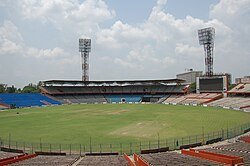
On 11 April 2006, PCB chairman Shahryar Khan announced an agreement on the allocation of games, under which India would host the final, Pakistan and Sri Lanka the semi-finals, and Bangladesh the opening ceremony. After being stripped of its status as a co-host, Pakistan proposed to host its allocated games in the United Arab Emirates as a neutral venue. They had played matches in Abu Dhabi, Dubai, and Sharjah in the preceding months.[citation needed] On 28 April 2009, however, the ICC announced that matches originally intended to be played in Pakistan would be reallocated. As a result, India hosted 29 matches across eight venues, including the final and one semi-final; Sri Lanka hosted 12 matches at three venues, including one semi-final; and Bangladesh hosted 8 matches at two grounds, as well as the opening ceremony on 17 February 2011. On 1 June 2010, the first tranche of tickets were put on sale after a meeting of the tournament's Central Organising Committee in Mumbai. The cheapest tickets cost 20 US cents in Sri Lanka. In January 2011, the ICC declared the Eden Gardens ground in Kolkata, India, to be unfit and unlikely to be complete by 27 February, when it was scheduled to host a match between India and England. The match was moved to Bangalore.

Media and promotion

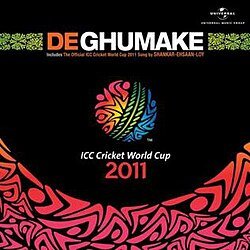
The World Cup has grown as a media event with each tournament.[citation needed] The ICC sold the broadcasting rights for the 2011 event to ESPN Star Sports and Star Cricket for around US$2 billion.[citation needed] For the first time, the tournament was broadcast in high-definition format, and it was to be covered by at least 27 cameras using recent technology. It was also planned to be shown across platforms such as online and mobile 3G. It was the first time that an ICC event had the Umpire Decision Review System (UDRS). The final was watched live by 135 million people in India, as recorded by the ratings agencies TAM and aMap, including 67.6 million Indian cable and satellite viewers. The final was watched by 13.6% of Indian TV-equipped households on average, with a peak of 21.44% at the end of the game, thus beating the semi-final between India and Pakistan, which had an estimated 11.74% TV rating in India for the whole match. The official event ambassador was Sachin Tendulkar. The official song of the 2011 Cricket World Cup has three versions, in Bengali, Hindi and Sinhala, corresponding to the three host countries. "O Prithibi Ebar Ese Bangladesh Ke Nao Chiney" (Bengali: ও পৃথিবী এবার এসে বাংলাদেশ নাও চিনে; English: O World It's Time Let Bangladesh Be Known), is a song composed by Ibrar Tipu and has been sung by Ibrar Tipu, Arnob, Mila, Balam, Kona and Elita Karim. The lyricist of the song is Zulfiqer Russell. It is the official welcome song for the 2011 world cup. It was released worldwide on February 17, 2011, at welcome ceremony. De Ghuma Ke (Swing It Hard) is the Hindi version, composed by the trio of Shankar–Ehsaan–Loy (Shankar Mahadevan, Ehsaan Noorani and Loy Mendonsa). It employs an array of Indian rhythms combined with elements of rock and hip hop. It was released worldwide on 31 December 2010. The song's lyrics were written by Manoj Yadav. "We were looking at various ideas to determine what direction we can take because we wanted to make a fun song, a dhamaal song on which people can dance, they can sing and we wanted to use more of a colloquial term, which was an idea that came in late. Initially, we were looking at a regular dance song and by chance we coined this phrase De Ghuma Ke. Everyone got excited and said why not make a song around the phrase," said Shankar. The song uses Hindi colloquialisms like aare paare ("this way or that") and juta hausla badla faisla ("buck up and change the game"), and has a rousing quality. It incorporates an array of Indian rhythms, as well as elements of rock and hip-hop. The song, according to the composers, avoids both the cliches of patriotism and run-of-the-mill Bollywood beats for a "fun and funky tune" with a "folksy feel and a hint of rustic Punjabi". Each member has brought in the song his own unique talent and experience, combining the Carnatic and Hindustani vocal tradition, Western rock, fusion and synthesiser techniques. The Sinhala version, "Sinha Udaane", was adapted by Sri Lankan R&B and hip hop artist Ranidu Lankage and composed by lyricist Shehan Galahitiyawa. Both songs were performed at the opening ceremony. "Sinha Udaane" was performed by Lankage. Zulfiqer Russell, who pens the lyrics, tried to highlight the Liberation War, Language Movement, Cricket Team, Sunderbans, Cox's Bazar, and various aspects of the world. Composed by Ibrar Tipu, the song features music from classical to folk and danata, from Sanai to the traditional domestic tunes. There was a lot of buzz about the song before it was released. Within two days of its release, De Ghuma Ke received nearly 7,000 hits on YouTube. In the next 30 days, over 0.5 million people listened to the song on YouTube. The song became quite popular among youths and cricket enthusiasts within days of its release. Stumpy, a young elephant, was the official mascot for the 2011 Cricket World Cup. He was unveiled at a function in Colombo, Sri Lanka, on 2 April 2010, and his name was revealed on 2 August 2010 after an online competition conducted by the ICC in the last week of July.

Opening ceremony

The opening ceremony was held in the National Stadium, Dhaka, Bangladesh, on 17 February 2011, two days before the first match.

Prize money

The 2011 Cricket World Cup winning team would be taking home a prize money of US$3 million and US$1.5 million for runner-up, with the ICC deciding to double the total allocation for the tournament to US$8.01 million. The winning team was also awarded a replica of the Cricket World Cup Trophy, a practice that originated in 1999. The decision was taken at the ICC Board meeting which was held in Dubai on 20 April 2010. US$250,000 – Losing quarter-finalists (4 teams) , US$500,000 – Losing semi-finalists , US$1,500,000 – Runners-up , US$3,250,000 – Winners

Venues

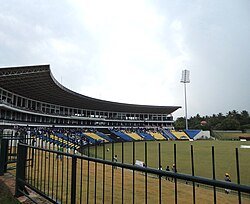
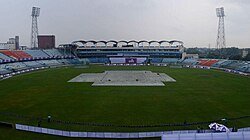
All the Indian stadiums for the tournament had been finalised by mid-October 2009, and those of Bangladesh and Sri Lanka in late October 2009. The ICC announced all the venues in Mumbai on 2 November 2009. Two new stadiums were constructed in Kandy and Sooriyawewa, Sri Lanka, for the event while a total of 7 matches were played down at the Premadasa, including a semi-final.

India
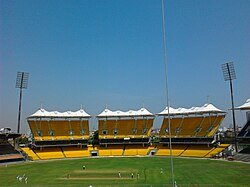
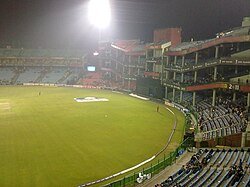
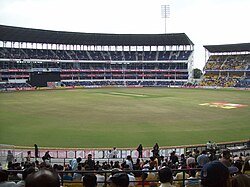
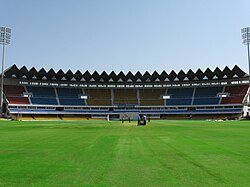
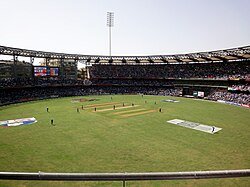
KolkataChennaiDelhiNagpurAhmedabad
Eden GardensM. A. Chidambaram StadiumFeroz Shah Kotla StadiumVidarbha CricketAssociation StadiumSardar Patel Stadium
Capacity: 66,349Capacity: 50,000Capacity: 41,820Capacity: 45,000Capacity: 54,000
MumbaiMohaliBangalore
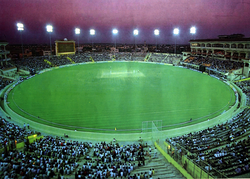
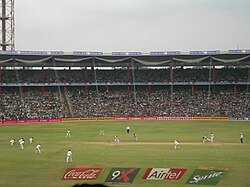
Wankhede StadiumPunjab CricketAssociation StadiumM. Chinnaswamy Stadium
Capacity: 33,108Capacity: 26,950Capacity: 40,000
Sri LankaBangladesh
ColomboKandySooriyawewaChittagongDhaka
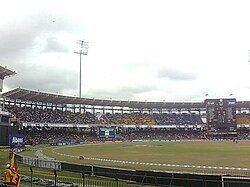
R. Premadasa StadiumPallekele InternationalCricket StadiumMahinda RajapaksaInternational Cricket StadiumZohur Ahmed Chowdhury StadiumSher-e-BanglaNational Cricket Stadium
Capacity: 35,000Capacity: 35,000Capacity: 35,000Capacity: 20,000Capacity: 26,000
KolkataNew DelhiAhmedabadChennaiMohaliNagpurBangaloreMumbai Venues in IndiaColomboSooriyawewaPallekele Venues in Sri LankaChittagongDhaka Venues in Bangladesh

Match officials

The umpire selection panel selected 18 umpires excluding a reserve umpire, Enamul Haque (Bangladesh) to officiate at the World Cup: five from Australia, three from England, two each from India, New Zealand, Pakistan and Sri Lanka, and one each from South Africa and the West Indies.

Squads

Each country chose a 30-member preliminary squad, which would then be reduced to 15. All the 14 teams announced their final squads before 19 January 2011. Sachin Tendulkar of India played in his sixth consecutive world cup, equalling the record of Pakistan's Javed Miandad.

Warm-up matches

The following 14 warm-up matches were played before the World Cup started, between 12 February and 18 February 2011. All 14 nations that were qualified to take part in the World Cup participated in a series of matches to prepare, experiment with different tactics and to help them acclimatise to conditions in the Indian subcontinent. The warm-up matches were not classified as One Day Internationals by the ICC, despite sharing some of main features of this form of cricket, but some of the playing regulations were different from standard internationals in order to allow teams to experiment. For example, the main change allowed for thirteen different players to play in a match – nine players being allowed to both bat and bowl, with two only being able to bowl and two only being able to bat – instead of the eleven players normally allowed. England, India, Sri Lanka and South Africa were the only teams to win both of their warm-up games, while Australia, Canada, Kenya and Zimbabwe did not win either of their fixtures.

Match status

As of 2007, none of the warm-up games were officially recognised as ODIs or List A matches by the ICC due to various changes in the rules of the game, and this continued into the 2011 World Cup. While normally only 11 players are allowed to bat and field (excluding situations involving a substitute fielder), 13 players were used in each team's squad for the matches – 11 of whom were allowed to field at one time and 11 of whom were allowed to bat (meaning players could be swapped in and out when fielding or bowling, but two players did not bat in a match). In official ICC matches match referees are required to help officiate a game, but due to the changes in the rules none were appointed for any of the warm-up games.

Matches

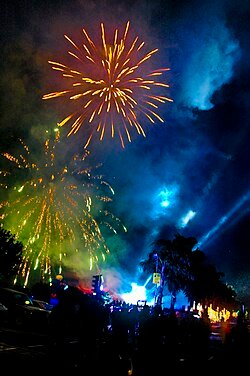
West Indies vs Pakistan West Indies won the toss and elected to bat. West Indies won the toss and elected to bat first. They lost early wickets and never recovered, being bowled out for 112. Pakistan won without losing a wicket. This was the West Indies' lowest score in the knockout stages. With this win, Pakistan has reached at least the Semi Final stages in five consecutive ICC tournaments, including one ICC Champions Trophy and three ICC World Twenty20. Australia vs India Australia won the toss and elected to bat. Australia's loss to India ended their 12-year reign as ODI world champions. Australia posted 260 for 6 wickets at the end of their innings with Ricky Ponting scoring 104 runs. In response, India chased down the target with 14 balls to spare. India's innings was built on half-centuries by Sachin Tendulkar, Gautam Gambhir and Yuvraj Singh, as well as an unbroken partnership of 74 between Yuvraj and Suresh Raina. Yuvraj won the man of the match. Jason Krejza and Shaun Tait (Both Aus) played his last ODI. New Zealand vs South Africa New Zealand won the toss and elected to bat. This was the sixth time New Zealand had qualified for the semi-final, equalling Australia's and Pakistan's record. England vs Sri Lanka England won the toss and elected to bat. Tillakaratne Dilshan and Upul Tharanga both made centuries as Sri Lanka chased down a target of 230 to win by ten wickets; this run chase set a new record for the highest successful run chase in a ten-wicket victory in ODI history. New Zealand vs Sri Lanka New Zealand won the toss and elected to bat. , Sri Lanka qualified for the final for third time after 1996 and 2007. For a second consecutive time Sri Lanka defeated New Zealand in the semi-finals of the World Cup and made it to the finals. This was the last match Muttiah Muralitharan played on Sri Lankan soil. India vs Pakistan India won the toss and elected to bat , India qualified for the final for third time after 1983 and 2003. , Ashish Nehra (Ind) played his last ODI. The match was attended by the prime ministers of both the countries, Yusuf Raza Gilani of Pakistan and Manmohan Singh of India. Anti-aircraft missiles were deployed at Mohali to prevent any air attacks. The local airport was full of private jets, and an estimated one billion people saw the match on television. Tickets for the match were selling for over ten times their normal selling price on the black market. India won the toss and elected to bat first. Sachin Tendulkar was dropped four times and survived an early leg before wicket decision before being dismissed for 85. India finished with a total of 260. Pakistan had a steady start, but India kept taking wickets and won by 29 runs. After the match was over Indian and Pakistani leaders pledged to resolve their differences, including cooperation in the investigation of the 2008 Mumbai attacks. Additionally the skies over Delhi were lit up with large numbers of fireworks. Sri Lanka won the toss and elected to bat. , Sreesanth (Ind), Muttiah Muralitharan and Thilan Samaraweera (SL) played in their last ODI. This was Sri Lanka's second consecutive loss in a World Cup Final and was also Muttiah Muralitharan's last ODI match, as well as Sachin Tendulkar's last World Cup match, having been playing World Cups for India since 1992. This match also recorded the highest successful run chase by any team in a World Cup Final and also only the third time that a team batting second had won the World Cup Final. This was also the first time that a host nation in their own country won the World Cup. The final was played on 2 April between India and Sri Lanka at Wankhede Stadium, Mumbai. India were crowned champions after winning by six wickets with only 10 balls remaining. India captain MS Dhoni was named man of the match after an unbeaten, match-winning innings of 91 runs off 79 balls, including the final shot that won the game. Gautam Gambhir contributed with a crucial knock of 97 after India lost early wickets. After the match, the Indian players paid tribute to Sachin Tendulkar, who was playing in his last World Cup. The final had a viewership of about 558 million people all over the world.

12 February 2011 Scorecard
West Indies 253/8 (50 overs)vKenya 192 (45.3 overs)
West Indies won by 61 runsR. Premadasa Stadium, Colombo
12 February 2011 Scorecard
Sri Lanka 351/5 (50 overs)vNetherlands 195 (47.3 overs)
Sri Lanka won by 156 runsSinghalese Sports Club Cricket Ground, Colombo
12 February 2011 (D/N)Scorecard
Canada 112 (37.3 overs)vBangladesh 113/1 (19.2 overs)
Bangladesh won by 9 wicketsZohur Ahmed Chowdhury Stadium, Chittagong
12 February 2011 (D/N)Scorecard
New Zealand 311/6 (50 overs)vIreland 279 (48.2 overs)
New Zealand won by 32 runsVidarbha Cricket Association Stadium, Nagpur
12 February 2011 (D/N)Scorecard
Zimbabwe 152 (41.5 overs)vSouth Africa 153/2 (23.3 overs)
South Africa won by 8 wicketsM. A. Chidambaram Stadium, Chennai
13 February 2011 (D/N)Scorecard
India 214 (44.3 overs)vAustralia 176 (37.5 overs)
India won by 38 runsM. Chinnaswamy Stadium, Bangalore
15 February 2011 Scorecard
Zimbabwe 244/8 (50 overs)vIreland 245/6 (49.3 overs)
Ireland won by 4 wicketsVidarbha Cricket Association Stadium, Nagpur
15 February 2011 Scorecard

Group stage

The top four teams from each group qualified for the quarter-finals (indicated in green). The top four teams from each group qualified for the Quarter finals (indicated in green).

Knockout stage

The knockout stage was the second and final stage of the 2011 Cricket World Cup. It featured the top four teams from each group (8 total) and contested as a single-elimination tournament. This was the first tournament in which a one-over eliminator would be used to decide matches that finished as ties; however, this decider was not required. India and Sri Lanka reached the final, where India chased down Sri Lanka's total of 274 runs for the loss of just four wickets to claim their second Cricket World Cup title.

Team of the tournament

Sachin Tendulkar , Tillakaratne Dilshan , Kumar Sangakkara (c & wk) , Mahela Jayawardene , AB de Villiers , Yuvraj Singh , Shane Watson , Shahid Afridi , Dale Steyn , Zaheer Khan , Muttiah Muralitharan , Tim Southee (12th man)

Controversies

Bangladeshi fans threw rocks at the West Indies team bus as it returned players to their hotel after their win over Bangladesh in Dhaka on 4 March. It was later claimed that the rock-throwers had confused the bus with the Bangladesh team bus. The elite Rapid Action Battalion of Bangladesh arrested 38 people after the attack, and the West Indies later received an apology. , The political party Shiv Sena threatened to disrupt the final in Mumbai if the Pakistani team qualified. , During the group stage match between India and England, Ian Bell was given not out for leg before wicket despite the ball hitting him in line with the wickets and being on a path to hit the stumps. India captain MS Dhoni referred the decision to the TV umpire, who confirmed the original decision as the ball had struck Bell at a point more than 2.5 m (8 ft 2 in) from the stumps, a point at which the reliability of the Hawk-Eye system diminishes below acceptable levels. Dhoni later complained that the rule had deprived his team of what seemed like an obvious wicket. The rules were subsequently revised and the umpires were given new guidelines. The Sri Lankan captain, Kumar Sangakkara, later criticised the decision to alter the 2.5-metre rule while a tournament was in progress. , In the final between India and Sri Lanka, loud crowd noise prevented match referee Jeff Crowe from hearing Sri Lanka captain Kumar Sangakkara's call as the coin was tossed by India captain MS Dhoni. The toss had to be redone – an extremely unusual event, especially at an event as prominent as the World Cup final. The second toss was won by Sri Lanka. , In June 2020, it was alleged that the final match was fixed and Sri Lanka sold the match to India. Former Sri Lankan Sports Minister Mahindananda Aluthgamage said, "The 2011 Cricket World Cup final was fixed. I stand by what I say. It took place when I was the Minister of Sports." Earlier, former Sri Lankan captain Arjuna Ranatunga also claimed the final to be fixed and demanded a probe into the matter. However, in July 2020, the investigation was dropped, after no supporting evidence could be provided to verify the allegations. The ICC added that they did not have a reason to doubt the integrity of the tournament's final.

In media

Footage of the final match was purchased by makers and used in their film M.S. Dhoni: The Untold Story (2016), a Bollywood film based on India captain MS Dhoni.

স্কোয়াড

Australia

No. Player
Ricky Ponting (c) (1974-12-19)19 December 1974 (aged 36)
Doug Bollinger3 (withdrawn) (1981-07-24)24 July 1981 (aged 29)
Michael Clarke (vc) (1981-04-02)2 April 1981 (aged 29)
Callum Ferguson1 (1984-11-21)21 November 1984 (aged 26)
Brad Haddin (wk) (1977-10-23)23 October 1977 (aged 33)
John Hastings (1985-11-04)4 November 1985 (aged 25)
David Hussey (1977-07-15)15 July 1977 (aged 33)
Michael Hussey3 (1975-05-27)27 May 1975 (aged 35)
Mitchell Johnson (1981-11-02)2 November 1981 (aged 29)
Jason Krejza2 (1983-01-14)14 January 1983 (aged 28)
Brett Lee (1976-11-08)8 November 1976 (aged 34)
Tim Paine (wk) (1984-12-08)8 December 1984 (aged 26)
Steve Smith (1989-06-02)2 June 1989 (aged 21)
Shaun Tait (1983-02-22)22 February 1983 (aged 27)
Shane Watson (1981-06-17)17 June 1981 (aged 29)
Cameron White (1983-08-18)18 August 1983 (aged 27)

Canada

No. Player
Ashish Bagai (c) (wk) (1982-01-26)26 January 1982 (aged 29)
Rizwan Cheema (vc) (1978-08-15)15 August 1978 (aged 32)
Harvir Baidwan (1987-07-31)31 July 1987 (aged 23)
Balaji Rao (1978-03-04)4 March 1978 (aged 32)
John Davison (1970-05-09)9 May 1970 (aged 40)
Parth Desai (1990-12-11)11 December 1990 (aged 20)
Tyson Gordon (1982-01-31)31 January 1982 (aged 29)
Ruvindu Gunasekera (1991-07-20)20 July 1991 (aged 19)
Jimmy Hansra (1984-12-29)29 December 1984 (aged 26)
Khurram Chohan (1980-02-22)22 February 1980 (aged 30)
Nitish Kumar (1994-05-21)21 May 1994 (aged 16)
Henry Osinde (1978-10-17)17 October 1978 (aged 32)
Hiral Patel (1991-08-10)10 August 1991 (aged 19)
Zubin Surkari (1980-02-26)26 February 1980 (aged 30)
Karl Whatham (1981-08-27)27 August 1981 (aged 29)
Hamza Tariq (wk) (1990-07-21)21 July 1990 (aged 20)

Kenya

No. Player
Jimmy Kamande (c) (1978-12-12)12 December 1978 (aged 32)
Maurice Ouma (wk) (1982-11-08)8 November 1982 (aged 28)
Tanmay Mishra (1986-12-22)22 December 1986 (aged 24)
James Ngoche (1988-01-29)29 January 1988 (aged 23)
Alex Obanda (1987-12-25)25 December 1987 (aged 23)
Collins Obuya (1981-07-27)27 July 1981 (aged 29)
David Obuya (wk) (1979-08-14)14 August 1979 (aged 31)
Nehemiah Odhiambo (1983-08-07)7 August 1983 (aged 27)
Thomas Odoyo (1978-05-12)12 May 1978 (aged 32)
Peter Ongondo (1977-02-10)10 February 1977 (aged 34)
Elijah Otieno (1988-01-03)3 January 1988 (aged 23)
Rakep Patel (1989-07-12)12 July 1989 (aged 21)
Steve Tikolo (1971-06-25)25 June 1971 (aged 39)
Seren Waters (1990-04-11)11 April 1990 (aged 20)
Shem Ngoche (1989-06-06)6 June 1989 (aged 21)

New Zealand

No. Player
Daniel Vettori (c) (1979-01-27)27 January 1979 (aged 32)
Brendon McCullum (wk) (1981-09-27)27 September 1981 (aged 29)
Hamish Bennett (1987-02-22)22 February 1987 (aged 23)
James Franklin (1980-11-07)7 November 1980 (aged 30)
Martin Guptill (1986-09-30)30 September 1986 (aged 24)
Jamie How (1981-05-19)19 May 1981 (aged 29)
Nathan McCullum (1980-09-01)1 September 1980 (aged 30)
Kyle Mills (1979-03-15)15 March 1979 (aged 31)
Jacob Oram (1978-07-28)28 July 1978 (aged 32)
Jesse Ryder (1984-08-06)6 August 1984 (aged 26)
Tim Southee (1988-11-11)11 November 1988 (aged 22)
Scott Styris (1975-07-10)10 July 1975 (aged 35)
Ross Taylor (1984-03-08)8 March 1984 (aged 26)
Kane Williamson (1990-08-08)8 August 1990 (aged 20)
Luke Woodcock (1982-03-19)19 March 1982 (aged 28)

Pakistan

No. Player
Shahid Afridi(c) (1977-03-01)1 March 1977 (aged 33)
Misbah-ul-Haq (vc) (1974-05-28)28 May 1974 (aged 36)
Kamran Akmal (wk) (1982-01-13)13 January 1982 (aged 29)
Abdul Razzaq (1979-12-02)2 December 1979 (aged 31)
Abdur Rehman (1980-03-01)1 March 1980 (aged 30)
Ahmed Shehzad (1991-11-23)23 November 1991 (aged 19)
Asad Shafiq (1986-01-28)28 January 1986 (aged 25)
Mohammad Hafeez (1980-10-17)17 October 1980 (aged 30)
Saeed Ajmal (1977-10-14)14 October 1977 (aged 33)
Shoaib Akhtar (1975-08-13)13 August 1975 (aged 35)
Umar Akmal (1990-05-26)26 May 1990 (aged 20)
Umar Gul (1984-04-14)14 April 1984 (aged 26)
Wahab Riaz (1985-06-28)28 June 1985 (aged 25)
Younis Khan (1977-11-29)29 November 1977 (aged 33)

Sri Lanka

No. Player
Kumar Sangakkara (wk) (c) (1977-10-27)27 October 1977 (aged 33)
Mahela Jayawardene (1977-05-27)27 May 1977 (aged 33)
Tillakaratne Dilshan (vc) (1976-10-14)14 October 1976 (aged 34)
Dilhara Fernando (1979-07-19)19 July 1979 (aged 31)
Rangana Herath (1978-03-19)19 March 1978 (aged 32)
Chamara Kapugedera (1987-02-24)24 February 1987 (aged 23)
Nuwan Kulasekara (1982-07-22)22 July 1982 (aged 28)
Lasith Malinga (1983-08-28)28 August 1983 (aged 27)
Angelo Mathews (1987-06-02)2 June 1987 (aged 23)
Ajantha Mendis (1985-03-11)11 March 1985 (aged 25)
Muttiah Muralitharan (1972-04-17)17 April 1972 (aged 38)
Thisara Perera (1989-04-03)3 April 1989 (aged 21)
Thilan Samaraweera (1976-09-22)22 September 1976 (aged 34)
Chamara Silva (1979-12-14)14 December 1979 (aged 31)
Upul Tharanga (1985-02-02)2 February 1985 (aged 26)

Zimbabwe

No. Player
Elton Chigumbura (c) (1986-03-14)14 March 1986 (aged 24)
Regis Chakabva (1987-09-20)20 September 1987 (aged 23)
Charles Coventry (wk) (1983-03-08)8 March 1983 (aged 27)
Graeme Cremer (1986-09-19)19 September 1986 (aged 24)
Craig Ervine (1985-08-19)19 August 1985 (aged 25)
Terry Duffin1 (1982-03-20)20 March 1982 (aged 28)
Greg Lamb (1981-03-04)4 March 1981 (aged 29)
Shingirai Masakadza (1986-09-04)4 September 1986 (aged 24)
Chris Mpofu (1985-11-27)27 November 1985 (aged 25)
Ray Price (1976-06-12)12 June 1976 (aged 34)
Tinashe Panyangara2 (1985-10-21)21 October 1985 (aged 25)
Tatenda Taibu (wk) (1983-05-14)14 May 1983 (aged 27)
Brendan Taylor (wk) (1986-02-06)6 February 1986 (aged 25)
Prosper Utseya (1985-03-26)26 March 1985 (aged 25)
Vusi Sibanda3 (1983-10-10)10 October 1983 (aged 27)

Bangladesh

No. Player
Shakib Al Hasan (c) (1987-03-24)24 March 1987 (aged 23)
Mushfiqur Rahim (wk) (1988-09-01)1 September 1988 (aged 22)
Tamim Iqbal (vc) (1989-03-20)20 March 1989 (aged 21)
Imrul Kayes (1987-02-02)2 February 1987 (aged 24)
Junaid Siddique (1987-10-30)30 October 1987 (aged 23)
Shahriar Nafees (1986-01-25)25 January 1986 (aged 25)
Mohammad Ashraful (1984-07-07)7 July 1984 (aged 26)
Raqibul Hasan (1987-10-08)8 October 1987 (aged 23)
Mahmudullah (1986-02-04)4 February 1986 (aged 25)
Naeem Islam (1986-12-31)31 December 1986 (aged 24)
Shafiul Islam (1989-10-06)6 October 1989 (aged 21)
Rubel Hossain (1990-01-01)1 January 1990 (aged 21)
Abdur Razzak (1982-06-15)15 June 1982 (aged 28)
Suhrawadi Shuvo (1988-11-21)21 November 1988 (aged 22)
Nazmul Hossain (1987-10-05)5 October 1987 (aged 23)

England

No. Player
Andrew Strauss (c) (1977-03-02)2 March 1977 (aged 33)
James Anderson (1982-07-30)30 July 1982 (aged 28)
Ian Bell (1982-04-11)11 April 1982 (aged 28)
Ravi Bopara1 (1985-05-04)4 May 1985 (aged 25)
Tim Bresnan (1985-02-28)28 February 1985 (aged 25)
Stuart Broad3 (withdrawn) (1986-06-24)24 June 1986 (aged 24)
Paul Collingwood (1976-05-26)26 May 1976 (aged 34)
Jade Dernbach4 (1986-04-03)3 April 1986 (aged 25)
Eoin Morgan2 (1986-09-10)10 September 1986 (aged 24)
Kevin Pietersen2 (withdrawn) (1980-06-27)27 June 1980 (aged 30)
Matt Prior (wk) (1982-02-26)26 February 1982 (aged 28)
Adil Rashid5 (1988-02-17)17 February 1988 (aged 23)
Ajmal Shahzad4 (withdrawn) (1985-07-27)27 July 1985 (aged 25)
Graeme Swann (1979-03-24)24 March 1979 (aged 31)
James Tredwell (1982-02-27)27 February 1982 (aged 28)
Chris Tremlett3 (1981-09-02)2 September 1981 (aged 29)
Jonathan Trott (1981-04-22)22 April 1981 (aged 29)
Luke Wright (1985-03-07)7 March 1985 (aged 25)
Michael Yardy5 (withdrawn) (1980-11-27)27 November 1980 (aged 30)

India

No. Player
Mahendra Singh Dhoni (c & wk) (1981-07-07)7 July 1981 (aged 29)
Virender Sehwag (vc) (1978-10-20)20 October 1978 (aged 32)
Gautam Gambhir (1981-10-14)14 October 1981 (aged 29)
Sachin Tendulkar (1973-04-24)24 April 1973 (aged 37)
Yuvraj Singh (1981-12-12)12 December 1981 (aged 29)
Suresh Raina (1986-11-27)27 November 1986 (aged 24)
Virat Kohli (1988-11-05)5 November 1988 (aged 22)
Yusuf Pathan (1982-11-17)17 November 1982 (aged 28)
Zaheer Khan (1978-10-07)7 October 1978 (aged 32)
Harbhajan Singh (1980-07-03)3 July 1980 (aged 30)
Ashish Nehra (1979-04-29)29 April 1979 (aged 31)
Munaf Patel (1983-07-12)12 July 1983 (aged 27)
S. Sreesanth1 (1983-02-06)6 February 1983 (aged 28)
Piyush Chawla (1988-12-24)24 December 1988 (aged 22)
Ravichandran Ashwin (1986-09-17)17 September 1986 (aged 24)

Ireland

No. Player
William Porterfield (c) (1984-09-06)6 September 1984 (aged 26)
Gary Wilson (wk) (1986-02-05)5 February 1986 (aged 25)
Andre Botha (1975-09-12)12 September 1975 (aged 35)
Alex Cusack (1980-10-29)29 October 1980 (aged 30)
George Dockrell (1992-07-22)22 July 1992 (aged 18)
Trent Johnston (1974-04-29)29 April 1974 (aged 36)
Nigel Jones (1982-04-22)22 April 1982 (aged 28)
Ed Joyce (1978-09-22)22 September 1978 (aged 32)
John Mooney (1982-02-10)10 February 1982 (aged 29)
Kevin O'Brien (1984-03-04)4 March 1984 (aged 26)
Niall O'Brien (wk) (1981-11-08)8 November 1981 (aged 29)
Boyd Rankin (1984-07-05)5 July 1984 (aged 26)
Paul Stirling (1990-09-03)3 September 1990 (aged 20)
Albert van der Merwe (1979-06-01)1 June 1979 (aged 31)
Andrew White (1980-07-03)3 July 1980 (aged 30)

Netherlands

No. Player
Peter Borren (c) (1983-08-21)21 August 1983 (aged 27)
Adeel Raja (1980-08-15)15 August 1980 (aged 30)
Wesley Barresi (wk) (1984-05-03)3 May 1984 (aged 26)
Mudassar Bukhari (1983-12-26)26 December 1983 (aged 27)
Atse Buurman (wk) (1982-03-21)21 March 1982 (aged 28)
Tom Cooper (1986-11-26)26 November 1986 (aged 24)
Tom de Grooth (1979-05-14)14 May 1979 (aged 31)
Alexei Kervezee (1989-09-11)11 September 1989 (aged 21)
Bradley Kruger (1988-09-17)17 September 1988 (aged 22)
Bernard Loots (1979-04-19)19 April 1979 (aged 31)
Pieter Seelaar (1987-07-02)2 July 1987 (aged 23)
Eric Szwarczynski (1983-02-13)13 February 1983 (aged 28)
Ryan ten Doeschate (1980-06-30)30 June 1980 (aged 30)
Berend Westdijk (1985-03-05)5 March 1985 (aged 25)
Bas Zuiderent (1977-03-03)3 March 1977 (aged 33)

South Africa

No. Player
Graeme Smith (c) (1981-02-01)1 February 1981 (aged 30)
AB de Villiers (wk) (1984-02-17)17 February 1984 (aged 27)
Hashim Amla (1983-03-31)31 March 1983 (aged 27)
Johan Botha (1982-05-02)2 May 1982 (aged 28)
JP Duminy (1984-04-14)14 April 1984 (aged 26)
Francois du Plessis (1984-07-13)13 July 1984 (aged 26)
Colin Ingram (1985-07-03)3 July 1985 (aged 25)
Jacques Kallis (1975-10-16)16 October 1975 (aged 35)
Morné Morkel (1984-10-06)6 October 1984 (aged 26)
Wayne Parnell (1989-07-30)30 July 1989 (aged 21)
Robin Peterson (1979-08-04)4 August 1979 (aged 31)
Dale Steyn (1983-06-27)27 June 1983 (aged 27)
Imran Tahir (1979-03-27)27 March 1979 (aged 31)
Lonwabo Tsotsobe (1984-03-07)7 March 1984 (aged 26)
Morne van Wyk (wk) (1979-03-20)20 March 1979 (aged 31)

West Indies

No. Player
Darren Sammy (c) (1983-12-20)20 December 1983 (aged 27)
Devon Thomas1 (wk) (1989-11-12)12 November 1989 (aged 21)
Kirk Edwards2 (1984-11-03)3 November 1984 (aged 26)
Sulieman Benn (1981-07-22)22 July 1981 (aged 29)
Devendra Bishoo3 (1985-11-06)6 November 1985 (aged 25)
Darren Bravo (1989-02-06)6 February 1989 (aged 22)
Shivnarine Chanderpaul (1974-08-16)16 August 1974 (aged 36)
Chris Gayle (1979-09-21)21 September 1979 (aged 31)
Nikita Miller (1982-05-16)16 May 1982 (aged 28)
Kieron Pollard (1987-05-12)12 May 1987 (aged 23)
Ravi Rampaul (1984-10-15)15 October 1984 (aged 26)
Kemar Roach (1988-06-30)30 June 1988 (aged 22)
Andre Russell (1988-04-29)29 April 1988 (aged 22)
Ramnaresh Sarwan (1980-06-23)23 June 1980 (aged 30)
Devon Smith (1981-10-21)21 October 1981 (aged 29)

তথ্যসূত্র: Wikipedia