Bangladesh team trainer Nathan Kiely is highly satisfied with the players’ fitness ahead of the Asia Cup.
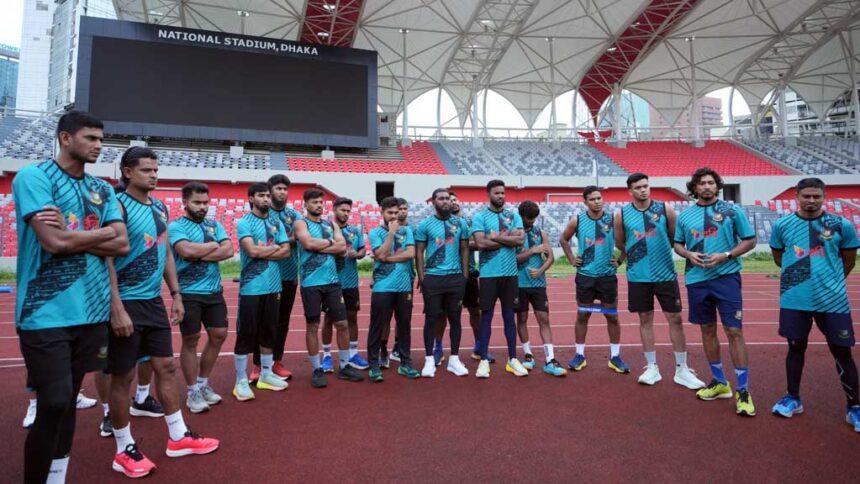
Early in the morning at the Sher-e-Bangla Stadium gymnasium, players engaged in various exercises before moving to the main field for running drills. The squad underwent multiple timed running trials, pushing themselves through exhausting routines that extended beyond the scheduled 9:30 am finish, lasting nearly until 10 am. By the end, some players collapsed to the ground, exhausted. As they made their way toward the academy ground, one player smiled and joked, “Everything’s out now, brother…,” adding humorously, “This fitness camp was really necessary.”
After a ten-day break following the Pakistan series on July 24, the players began this fitness camp. Not only the BCB and national team coaching staff but also the players themselves felt the need for this camp, given the back-to-back series and tournaments ahead.
Following several days of fitness training, Nathan Kiely spoke to the media Tuesday morning, expressing great satisfaction with the team’s fitness levels.
In the past, Bangladesh fitness camps focused on Yo-Yo or beep tests, both of which have been used at different times for the national side. However, since Kiely’s arrival, a new test—the time trial—has been introduced. This involves running 1600 meters on the athletic track at the national stadium. The latest camp’s time trial was held last Sunday, where the country’s fastest bowler Nahid Rana topped the list by completing the run in 5 minutes 31 seconds.
Although Yo-Yo and beep tests are widely popular, Kiely explained why time trials are the preferred choice for Bangladesh.
“There is often debate about which test is the best. I chose the time trial because it’s simple and adaptable for us. Running four laps around an athletic track requires no special equipment and can even be done on a grassy cricket field. It’s easier to implement not only with the national team but also in our domestic cricket,” he said.
“Also, there’s less controversy around time trial results. Sometimes players narrowly fail Yo-Yo or beep tests, but stopping them before completion is difficult. The great thing about the time trial is the clock never lies. In my experience, those who pass the Yo-Yo or beep tests also perform well in time trials. Players who don’t do well in those tests tend to struggle with time trials too.”
Before the national league starts, domestic players will also undergo the time trial. Kiely pointed out another benefit of choosing the time trial: it creates a consistent fitness benchmark that links domestic players with national players.
“This helps us understand which players are fit and which need more work, regardless of the test. For me, the key was to find a test that’s easy to administer and produces reliable results, whether for the national team or a domestic league squad. Conducting running tests this way maintains consistent standards.”
Kiely also clarified that overall fitness doesn’t depend solely on time trial performance.
“Some players might not do well in the time trial but may show excellent results in strength tests at the gym. It’s possible that we focus more on certain areas for specific players. The whole point is to identify where they are strong and where they need improvement. Players themselves know where to work, and their effort and attitude towards improving everywhere are impressive.”
Alongside Nahid Rana’s outstanding time trial result, eleven other players achieved personal bests. Strength tests also showed a surge in personal best performances, making Kiely enthusiastic about the players’ progress.
“We conducted some tests at the national stadium that included sprinting and time trials. Twelve players set personal best timings in the time trial, showing significant improvement. Nahid Rana’s 5:31 for 1600 meters was especially impressive. As a team, we are striving to improve overall.”
“At the Mirpur gym, we also did strength tests. Across all tests, we recorded 56 personal best performances, indicating overall progress in the squad.”
Due to their packed schedules, Bangladesh players rarely get dedicated time to focus on fitness. Kiely was eager to make the most of this opportunity.
“When we find a little free time in the schedule, we try to get the players doing physical training. It’s a great chance to work on fitness. Bangladesh is unique in that our players compete nearly year-round. Many Western teams have off-seasons, but we don’t have that luxury. So whenever there’s a gap, we try to do physical work and assessments.”
“These tests help us decide what to emphasize in each player’s individual training. Passing or failing isn’t the point here. It’s about understanding each player’s fitness strengths and weaknesses to help plan their personal training programs.”
Kiely also praised the players’ commitment to fitness, even during breaks.
“Whenever there’s a break, these players take responsibility for their own fitness. After the last series, they worked even harder. When playing matches every two or three days, doing physical work is harder. On the Sri Lanka tour, around 70% of the days were match days. Over the last few weeks, players have kept up with gym and running sessions, working hard. I can’t question their effort. As you saw today, their commitment and mindset towards fitness are exceptional.”
“They don’t need motivation from me. They’re already highly motivated, hardworking, and eager to be the best they can be. I’ve never heard any complaints about physical training from any player. Everyone tries their hardest to improve, and their energy and enthusiasm are fantastic.”
This fitness training continues for one more day, after which skill training for batting and bowling will begin. Following several days of skill work in Mirpur, the team will travel to Sylhet for the T20 series against the Netherlands starting August 30.