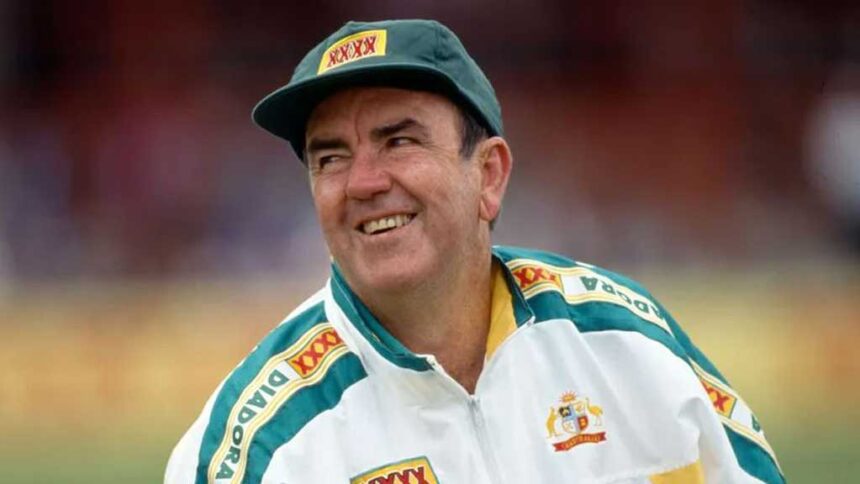
Bob Simpson, former Australian captain and coach, and one of cricket’s most influential figures, has passed away.
The legendary cricketer, who shaped Australian cricket in numerous roles—including as the country’s first full-time coach—died on Saturday at the age of 89. He was widely regarded as one of the most impactful personalities in Australian cricket history.
Simpson played 62 Tests and two ODIs for Australia. While his playing career alone was remarkable, he went on to leave an even greater mark after retirement. As a coach and selector, he transformed Australian cricket, earning a place of honor on its pages of history.
A resolute opening batsman, Simpson gradually enriched his batting with a variety of strokes. Renowned for his singles, he scored 4,869 runs at an average of 46.81. He also claimed 71 wickets with leg-spin and was considered one of the finest slip fielders of all time, taking 110 catches.
Simpson began his first-class career for New South Wales at just 16 and played until he was 42. Over his career, he scored more than 21,000 runs in 60 centuries at an average of 56.22 and took 349 wickets, along with 383 catches.
His opening partnership with Bill Lawry remains one of the greatest in Australian cricket. Together, they scored 3,595 runs in 62 innings at an average of 60.94, still Australia’s third most successful opening pair. Their 382-run stand at the Brisbane Test in 1965 remains an Australian record. Both achieved double centuries before legendary bowlers like Wes Hall, Charlie Griffith, Gary Sobers, and Lance Gibbs.
Simpson made his Test debut at 21 during the 1957 tour of South Africa, scoring 60 at number six. He opened for the first time in his seventh Test, scoring 92 in his first innings as an opener.
Despite establishing himself as a consistent contributor with both bat and ball, he had to wait until his 30th Test to score his first Test century—a milestone he celebrated with a marathon innings of 311 at Old Trafford during the 1964 Ashes, batting 762 minutes and facing 743 balls. This innings ranks as the third-longest in Test history by balls faced, and twelfth-longest by minutes.
Simpson retired from Test cricket in January 1968 after 52 matches but remained involved as a commentator and administrator. Nearly a decade later, he returned to the field in the revolutionary World Series Cricket organized by Kerry Packer, which shook world cricket.
At 42, he answered his country’s call again as Test captain, producing unforgettable performances with both the bat and leadership. In a fiercely competitive series against India, he led Australia to a 3-2 series victory, scoring two centuries and two fifties to finish as the top scorer with 539 runs.
He later captained Australia in a five-Test series in the West Indies, though age caught up with him against the Caribbean pace attack. All ten of his Test centuries came as captain, and in 39 Tests as skipper, he averaged 54.07 compared to 33.67 in 23 Tests without the captaincy.
In the mid-1980s, when Australian cricket was in turmoil with two years without a Test series win, Simpson returned as coach. Alongside captain Allan Border, he restored Australia’s pride and built the foundation for a bright future.
As a player, Simpson had always been ahead of his time; as a coach, he was even further ahead. He emphasized discipline, fitness, fielding, creativity, and hard work, creating a culture that restored Australian cricket to its dominant position. Under his guidance, Australia won the 1987 World Cup and reclaimed the Ashes in 1989, holding the urn until 2005. He also led the team to victory in the Frank Worrell Trophy against the West Indies in 1995, earning Australia an informal title of the world’s number one team.
Many players—including David Boon, Dean Jones, Steve Waugh, Craig McDermott, and Merv Hughes—developed into greats under Simpson’s mentorship. He also served on the selection panel from 1987, shaping Australian cricket for years and giving opportunities to stars like Mark Taylor, Steve Waugh, Shane Warne, Justin Langer, Matthew Hayden, Glenn McGrath, Damien Martyn, Ricky Ponting, and many others. Australia reached the 1996 World Cup final under his coaching, after which he stepped down.
Simpson was widely regarded as one of the greatest coaches of all time, admired by legends like Shane Warne.
After leaving Australian cricket, he coached in English county cricket with Leicestershire and Lancashire and served as a coaching advisor in India’s Ranji Trophy. He was also an advisor for India during the 1999 World Cup and helped the Netherlands qualify for their first World Cup in 2007.
Simpson was named Wisden Cricketer of the Year in 1965. He was awarded the Order of Australia in 1978, later upgraded to Officer of the Order of Australia in 2007, and was honored in both the ICC and Australian Cricket Hall of Fame.
With all his achievements and honors, Bob Simpson has departed this world—but only in body. His legacy in cricket has long ensured his immortality.