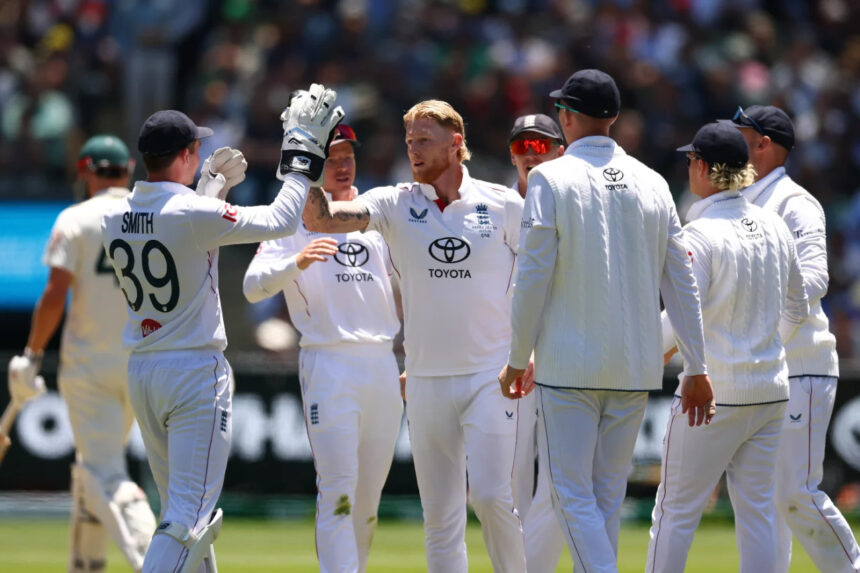
After 20 wickets fell on the opening day, the match ended on the second day, as England—already having lost the series—finally tasted a Test victory on Australian soil after a long wait.”
As the team edged closer to victory, England supporters in the stands burst into song. When the winning runs came through a leg-bye boundary, the singing turned into a roar. Even the commentary box echoed with emotion: “Finally… after 5,468 days, 15 years and 18 Tests, England have won a Test match in Australia…”
The match lasted just two days—and that was all it took for a result. The drama of 20 wickets falling on the first day hinted at what was to come, and Saturday delivered exactly that. Like the opening Test of the series, the fourth Test also finished inside two days. The difference was the outcome. Australia had begun the Ashes by retaining the urn with victory in Perth, but despite losing the series, England finally ended their long wait with a win in Melbourne.
England defeated Australia by four wickets in the Boxing Day Test.
Their previous Test win in Australia had come back in January 2011, when Andrew Strauss’s side sealed a famous series victory with a win in Sydney.
Since that Test, England had played 18 matches in Australia—losing 16 and drawing two. At last, a victory came their way.
For Joe Root, England’s most successful batter in Test history, this was his first taste of a Test win in Australia after 18 matches across four tours.
The Perth Test had finished in just 852 balls. Melbourne lasted only five balls longer. It was the first time in 137 years that multiple Tests in the same Ashes series ended inside two days.
On the pace-friendly Melbourne surface, England’s fast bowlers laid the foundation for victory. Despite bowling Australia out for 152 in the first innings, England could not take the lead due to batting failures. In the second innings, however, they dismissed Australia for just 132.
Brydon Carse claimed four wickets, while captain Ben Stokes took three.
Even so, a target of 175 was far from easy. Australia fought hard, but despite stumbling at various stages after an aggressive start, England eventually crossed the line.
Australia began the second day at 4 without loss, holding a 42-run first-innings lead. The surprise move of opening with Scott Boland did not last long. Jake Weatherald, batting at No. 3, was bowled by Stokes after leaving the ball.
Marnus Labuschagne, struggling for runs, was caught in the slips. There was some doubt over Joe Root’s catch, but after multiple replays, the third umpire ruled him out—much to Labuschagne’s visible frustration. After scoring 65 in the first innings of the series, he managed just 49 runs across his next five innings.
At the other end, Travis Head tried to push the score forward, batting in his usual aggressive style on a difficult pitch. But on 46, he was bowled by a superb delivery from Carse that gave the batter very little chance.
Steven Smith then held one end, but no one could stay with him. Usman Khawaja fell for a duck to a short ball, while in-form Alex Carey threw his wicket away with a loose shot.
Australia briefly found hope during the Smith–Cameron Green partnership, but Green gifted his wicket after scoring 19 with a poor shot.
That 31-run stand turned out to be the highest partnership of Australia’s innings.
The lower order offered little resistance. Captain Smith remained unbeaten on 24 from 39 balls.
Chasing 175 on a batter’s nightmare of a pitch was never going to be easy. But the aggressive start from Ben Duckett and Zak Crawley gave England belief. By the seventh over, the pair had already taken the score past 50. Duckett, under investigation for alleged excessive alcohol consumption, crossed 30 for the first time in the series.
Duckett’s innings ended on 34 from 26 balls when Mitchell Starc bowled him with a superb yorker.
England then tried a surprise move by promoting Carse to No. 3, but it did not pay off. Jai Richardson dismissed him to claim his first Test wicket in four years.
After lunch, the partnership between Crawley and Jacob Bethell pushed England firmly towards victory. Their 47-run stand virtually sealed the result.
Crawley was dismissed for 37 by Scott Boland, while Bethell played a valuable knock of 40 from 46 balls before being caught brilliantly by Usman Khawaja.
Even Joe Root and Ben Stokes failed to stay until the end, as Australia continued to fight. But England brushed aside any late nerves to secure the win.
Josh Tongue, who added two second-innings wickets to his five from the first innings, was named Player of the Match.
The first day of the Test saw a record crowd at the Melbourne Cricket Ground, and the second day also attracted record attendance. Cricket Australia had expected more than 150,000 spectators across the first three days combined. However, the third day—and the rest of the match—was lost to a bowling-friendly pitch and batting collapses.
Cricket Australia had suffered an estimated $5 million loss after the Perth Test ended inside two days. That figure is expected to rise even further after the Melbourne Test.
Brief scores
- Australia 1st innings: 152
- England 1st innings: 110
- Australia 2nd innings: 132 in 34.4 overs (overnight 4/0)
Boland 6, Head 46, Weatherald 5, Labuschagne 8, Smith 24*, Khawaja 0, Carey 4, Green 19, Nisar 0, Starc 0, Richardson 7
Atkinson 5-1-20-1, Carse 11-3-34-4, Tongue 11-2-44-2, Stokes 7.3-1-24-3 - England 2nd innings: 178/6 in 32.2 overs (target 175)
Crawley 37, Duckett 34, Carse 6, Bethell 40, Root 15, Brook 18*, Stokes 2, Smith 3*
Starc 10-0-55-2, Nisar 8-1-54-0, Richardson 5.1-1-22-2, Boland 9-1-22-2
Result: England won by 4 wickets
Series: Australia lead the five-match series 3–1
Player of the Match: Josh Tongue