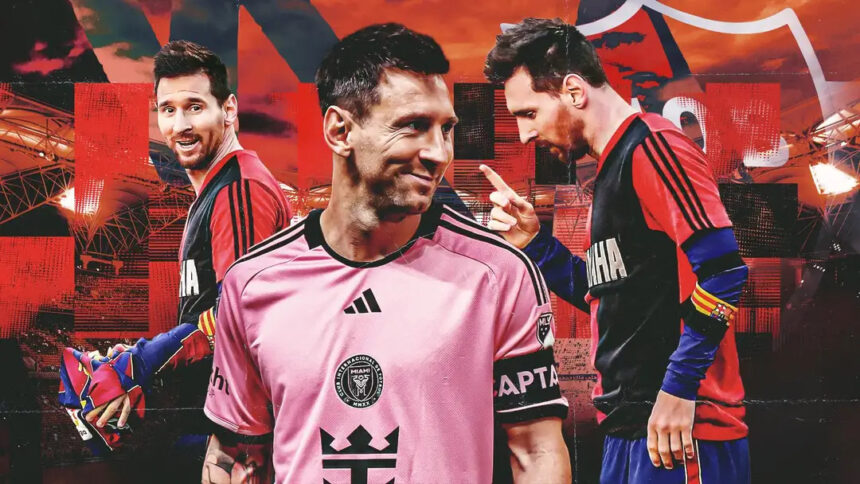
The Argentine club wants to have the football magician back in the first half of 2027.
Bringing home their local hero Lionel Messi has been a long-standing dream for Newell’s Old Boys, even if only for a short spell at the tail end of his career. With that goal in mind, they have now put their plans into action.
Juan Manuel Medina, the club’s first vice president, spoke about this initiative. The club is dreaming of seeing Messi in a Newell’s jersey in the first half of 2027.
“This project is not just about Newell’s. It involves the city of Rosario, the province, and Argentine football as a whole.”
Messi, who grew up in Newell’s youth academy, joined Barcelona at the age of 13 and spent the majority of his career there. However, in 2021, he left his beloved club against his wishes to join PSG.
His two years in France were not ideal, and he later moved to Inter Miami. His time in the U.S. club, however, has been exceptional. Even at 38, he continues to enchant the field with his magical football.
Since its founding in 2018, the club has risen to compete for trophies on Messi’s shoulders. They have already won three trophies, including their greatest success last season—the MLS Cup. Messi’s extraordinary contribution has been present in every title they’ve won.
Messi has also made history in Major League Soccer, becoming the first player to win the MVP award two consecutive seasons, achieved in the last two campaigns. In October, he signed a new contract with the club, keeping him there until the end of 2028.
Getting Messi back will undoubtedly be a tough challenge for Newell’s. Yet Medina remains confident.
Bringing Messi back is not just about the ordinary course of football at Newell’s, he said directly. The entire strategic plan was reportedly crafted back in 2024, with Messi’s return being a key part.
The club aims to enhance its overall development, create a competitive environment, and elevate Newell’s in the world of football.
According to media reports, the club has already begun informal talks with Messi’s representatives, although no significant progress has been made yet.